Plug two GEO tools into the same brand on the same day and you will get two different visibility scores. Neither one is lying. They simply don't query the same engines, with the same prompts, at the same frequency. That is the whole difficulty when you go looking for the best GEO tools: the dashboards look alike, every pricing page says "50 prompts", and yet the yearly bill can double for an identical scope.
So we did the tedious part. In November 2026 we read the price grids of five AI visibility tools line by line, recalculated the cost per tracked prompt and priced four budget scenarios. The result dents a few reputations, including that of one of the tools European agencies quote most often.
What is a GEO tool, exactly?
A GEO tool is software that measures how often a brand appears in the answers of generative AI engines (ChatGPT, Gemini, Perplexity, Claude, Mistral, Google AI Overviews) and tells you what to fix in order to get cited. Every day it sends a list of questions, the prompts, to those engines and analyzes what comes back.
In practice, most tools on the market report the same metrics:
- Visibility: the share of answers that mention your brand across a given set of prompts.
- Position: your rank in the list of brands cited.
- Sentiment: the tone the model uses when it talks about you.
- Share of voice: your weight against competitors on the same questions.
- Sources: the pages, yours or someone else's, that the engine uses to build its answer.
Why care now? Because clicks are getting scarce. An Ahrefs study of 963 French domains, published in September 2026, measured a 23.1% drop in median click-through rate for the sites most exposed to AI Overviews. And the discipline now rests on research: the Princeton team that coined the term in the paper "GEO: Generative Engine Optimization" showed that content reworked with sources, quotations and statistics can gain up to 40% visibility in generative answers. If the topic is new to you, our complete guide to Generative Engine Optimization covers the basics.
So you need to measure. But with what?
The best GEO tools compared: the table
Prices below are for entry plans, excluding tax, billed monthly unless stated otherwise. Cost per prompt is a plain division: plan price by number of tracked prompts.
| Tool | Entry price | Tracked prompts | Engines included | Cost per prompt | Best for |
|---|---|---|---|---|---|
| Citeme | $69/month ($59 billed yearly) | 50 per day | 3 of 10, extra engine at $25 | $1.38 | Measuring, fixing and proving revenue |
| Sorank | $49/month billed yearly ($99 month to month) | 10 | ChatGPT, Claude, Gemini | Not comparable (20 articles included) | Producing content and links at volume |
| Peec AI | $95/month | 50 per day | 3 of your choice, extra engine from $30 to $140 | $1.90 | Competitive benchmarking for agencies |
| Meteoria | €75/month | 25 per day | 3 of your choice | €3.00 | Multi-brand teams, EU hosting |
| Promptwatch | $95/month | 50 per day | All models | $1.90 | Covering as many engines as possible |
This table has a flaw, and we may as well admit it: it compares entry plans. Nobody stays on an entry plan for long. The real bill is decided by the add-ons, and that is where the gaps get uncomfortable. We come back to it after the ranking.
Our ranking of the 5 best GEO tools
1. Citeme: the tool that goes from measurement to revenue
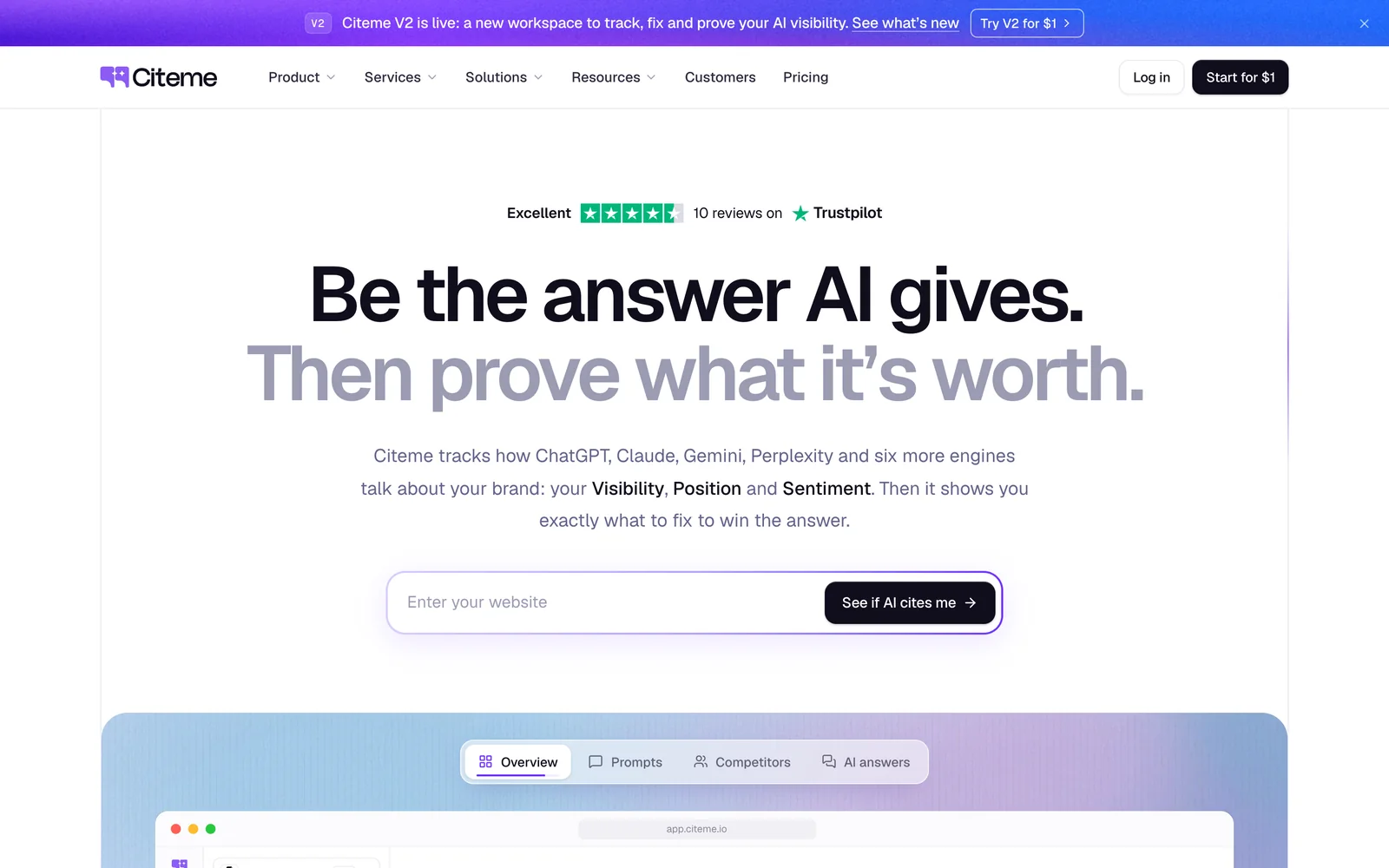
Citeme is a Paris-based GEO platform that tracks, every day, what ten AI engines say about a brand: ChatGPT, Claude, Gemini, Perplexity, Grok, DeepSeek, Meta AI, Mistral, Siri AI and Google AI Overviews. It does not stop at the dashboard, and that is what puts it first.
Three things set it apart from the rest of this comparison:
- Nova, an agent that fixes things. It detects visibility drops, drafts the fix and publishes it to your CMS (WordPress, Webflow, Shopify) once you approve. Nothing goes live without your sign-off, and every run is logged.
- Proof of revenue. The AI Impact module ties a visit coming from an AI answer to the landing page, the likely prompt and the order. It is the only serious answer to the question every executive ends up asking: "and what does this bring in?"
- A costed action plan. Each gap becomes a dated task with an estimated gain in points on the GEO Score, a 0 to 100 rating that combines visibility, authority and sentiment.
On pricing, the Starter plan begins at $69 per month ($59 billed yearly) for 50 prompts per day across 3 engines, with unlimited users. Growth, at $149, moves to 125 prompts, 4 engines and 3 brands, and unlocks Nova. Pro, at $349, adds the MCP server, the API and AI Shopping tracking. An extra engine costs $25 per month on any plan. Hold on to that detail; it matters later.
Citeme also publishes, on its pricing page, a chart we would like to see from every vendor: the cost of one tracked prompt, plan by plan, competitors included.
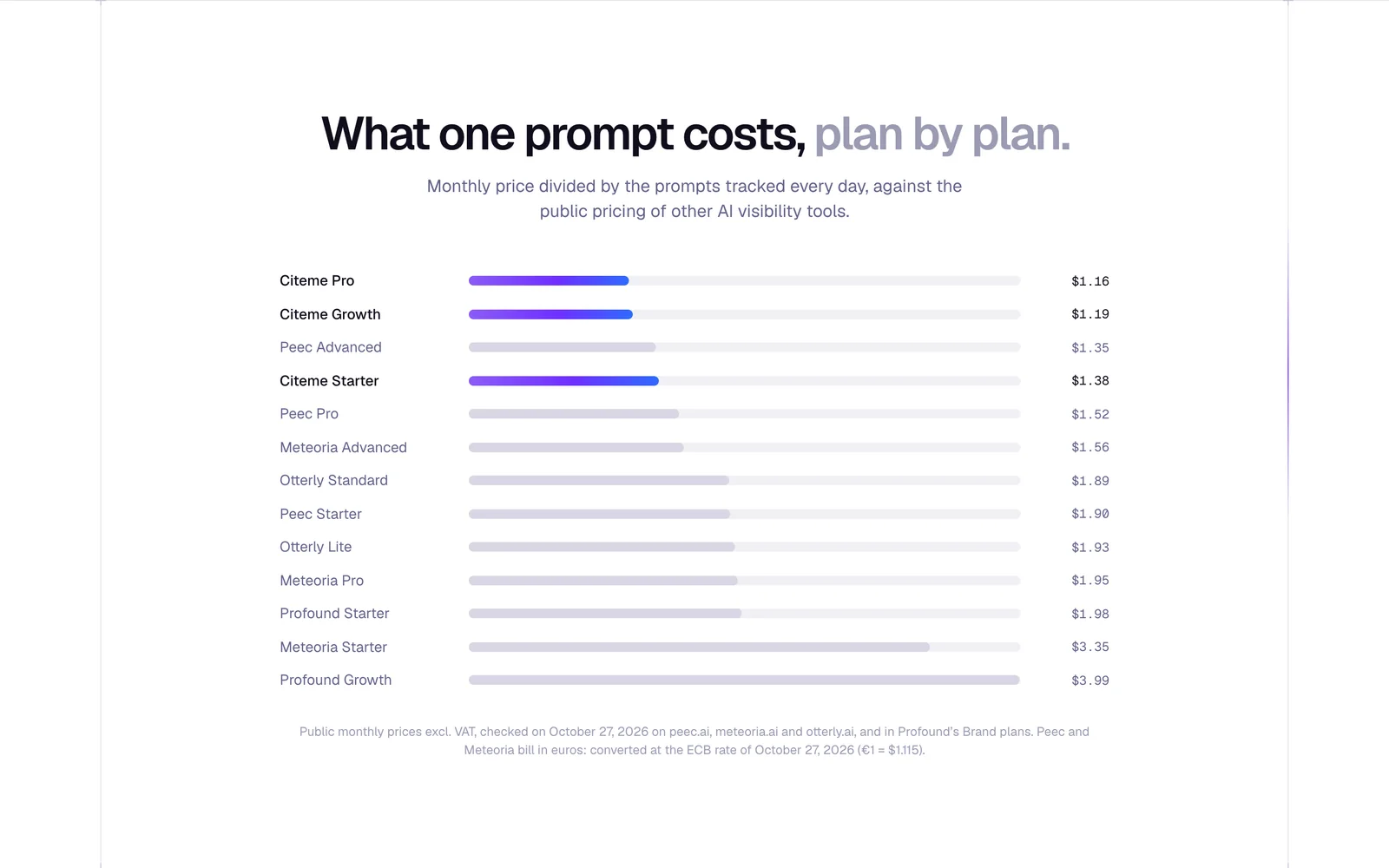
Read it without indulgence: Citeme Growth and Pro lead, but Starter ($1.38) is edged out by Peec Advanced. Base price does not tell the whole story, and we will see below what really makes the difference.
Our own testing backs the positioning. In our quarterly review of four AI tools for SEO and GEO, five reviewers (three in-house, two clients) read articles blind: the ones produced with Citeme were the only ones nobody labeled "generic AI". The vendor also publishes a customer case showing +248% AI citations in 90 days. That is a vendor figure and should be read as one.
The limits, because there are some. Only three engines on Starter. Nova arrives with Growth, MCP and the API with Pro. The free trial only lasts three days, and there is no free plan beyond it. And the product is young, with about ten Trustpilot reviews at the time of writing.
Our take: the best balance of price, engine coverage and ability to act. If you only test one tool from this list, start here.
2. Sorank: the content machine that also tracks mentions
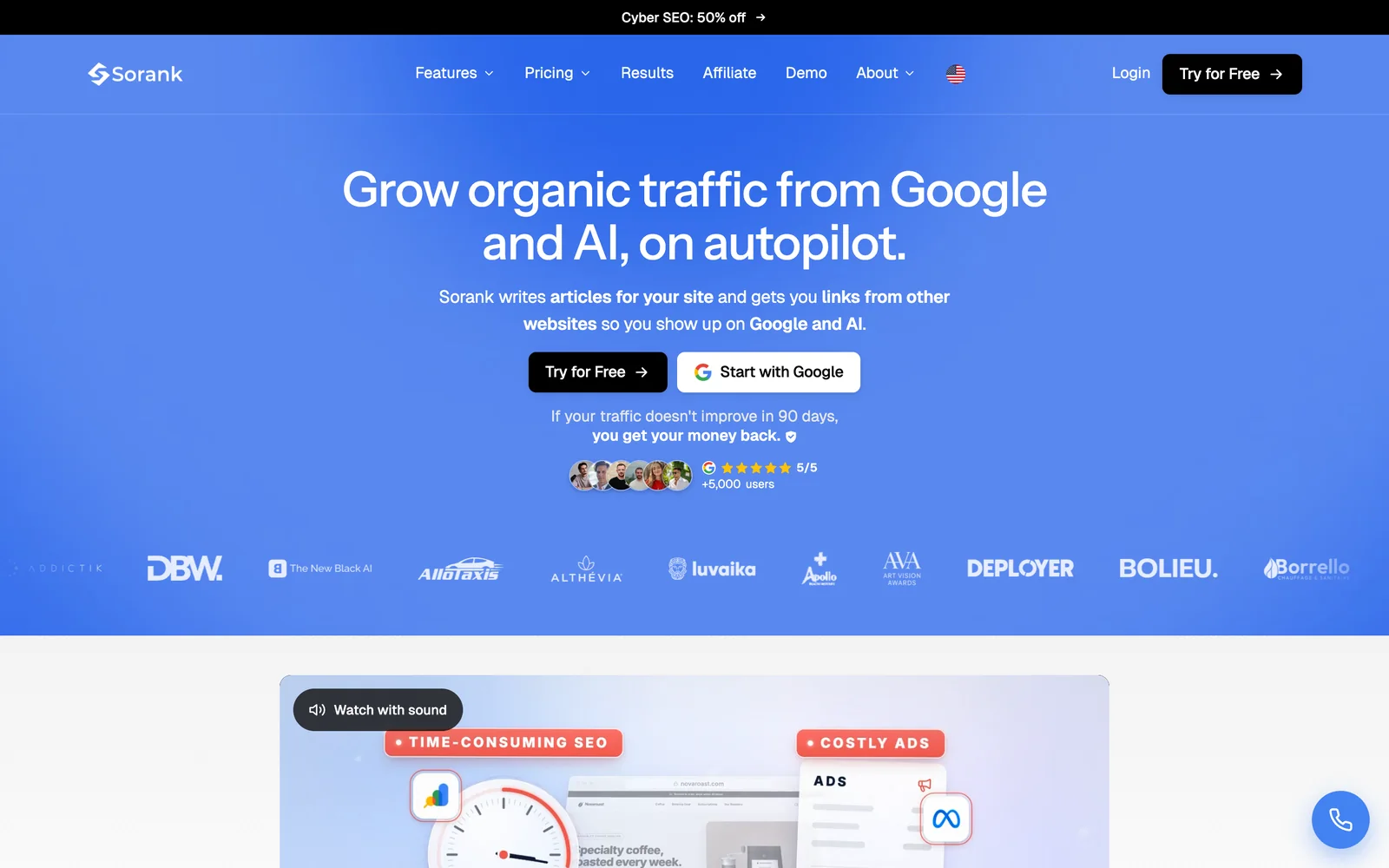
Sorank does not play in the same category, and that is exactly why it comes second. Where the others measure, it produces: sourced blog articles with internal links and images, published straight to more than ten CMS platforms, plus backlinks earned through a network of users.
The Essential plan costs $49 per month billed yearly and includes 20 articles, 200 keyword credits and tracking for 10 prompts on ChatGPT, Claude and Gemini. Pro ($129 billed yearly) goes up to 60 articles and 20 prompts, and adds Grok, a dedicated SEO and GEO specialist and 100 backlink credits per month. Sorank advertises a three-day free trial and a refund if traffic has not improved after 90 days.
What we like: the MCP server for driving the tool from Claude or ChatGPT, the analysis of "fan-out" queries (the sub-queries AI engines run behind the scenes), and the underlying idea that AI visibility is won with published content first, not with a chart.
What holds us back:
- Tracking is thin. Ten prompts on Essential, fifty on the $249 Business plan. Perplexity and AI Overviews do not appear in the plans' lists of tracked engines.
- Monthly billing costs double. $99 month to month against $49 on a yearly commitment: the grid pushes hard toward a one-year contract.
- The link network. Sorank states it uses neither PBNs nor reciprocal exchanges. We stay cautious on principle with any pooled link system, and we advise filtering by domain authority.
Our take: an excellent companion to a measurement tool, a poor replacement for one. Sorank makes the material; it will not tell you in enough detail whether that material gets cited.
3. Peec AI: the agency favorite, at a price that is hard to defend
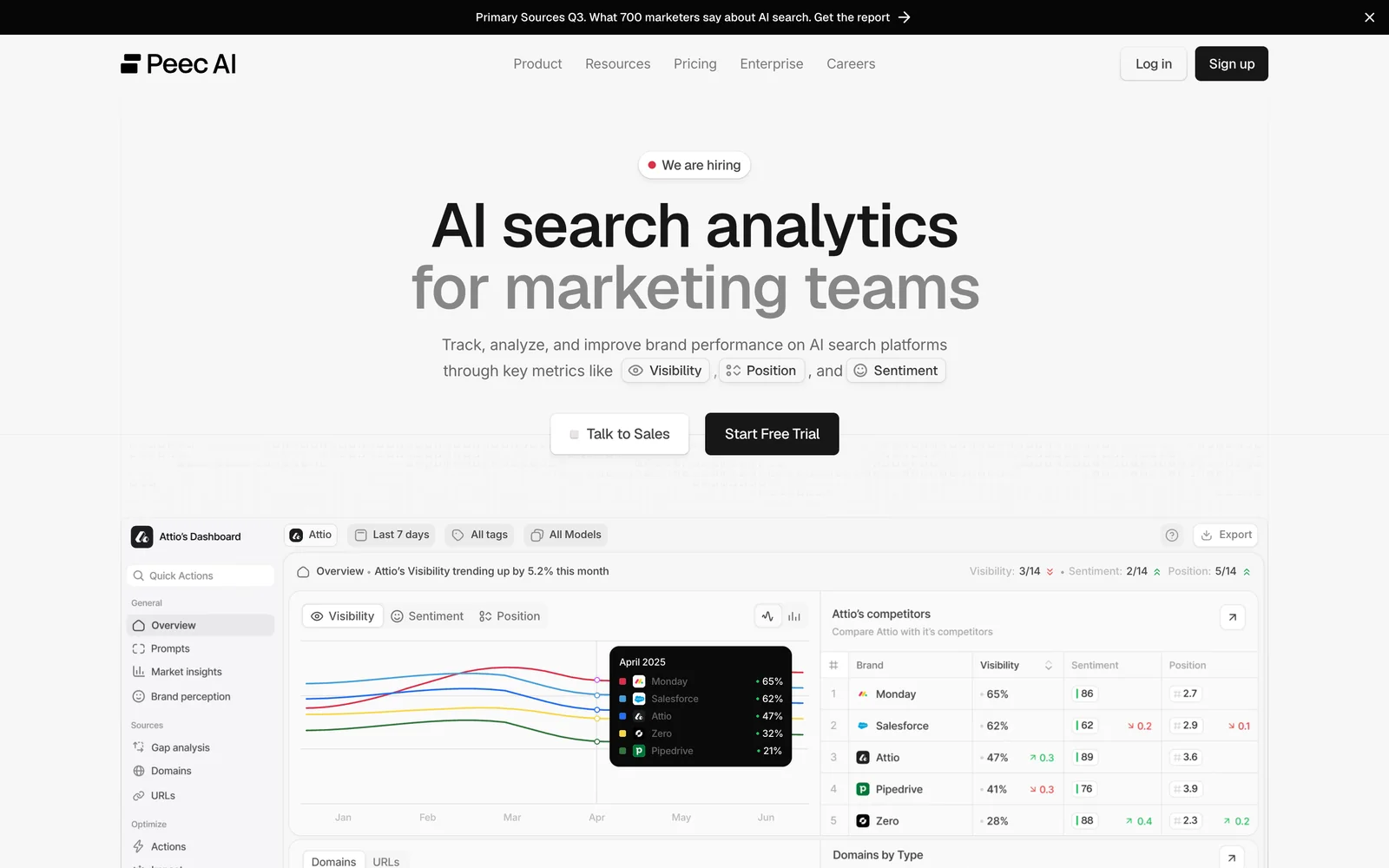
Peec AI is the Berlin tool everybody mentions. More than 4,000 brands and agencies use it, it scores 4.7 out of 5 on G2, and credit where it is due: stable daily readings, a readable competitive benchmark, clean source analysis, an MCP server, an API and a Looker Studio connector. For putting numbers in front of a client, it is comfortable.
Now let's get the calculator out.
The Starter plan costs $95 per month for 50 prompts across 3 engines and a single country. Citeme charges $69 for the same scope. Peec is therefore 38% more expensive at entry level, with nothing extra on that plan to show for it.
It gets worse with add-ons. At Peec, the price of an extra engine rises with your plan: $30 per month on Starter, $70 on Pro, $140 on Advanced. At Citeme it stays at $25 on every plan. On an Advanced plan ($495, 350 prompts) with five engines, the bill reaches $775 per month, or $9,300 a year.
To be fair, Peec's base cost per prompt improves as you move up the range, as the chart above shows. What derails the bill is the three-engine cap and an add-on priced by volume.
And there is more:
- Claude, Mistral, Grok and DeepSeek are reserved for the Enterprise plan, on quote. Putting engines that widely used behind a sales call is a real gap.
- Peec measures; it does not execute. Its Actions module produces recommendations along the lines of "consider investing in digital PR". No drafting, no publishing. The work is still entirely yours to do.
- No Search Console or GA4 connector is advertised on the site: tying visibility to real traffic means stitching things together through the API or Looker Studio.
Our take: a good measuring instrument sold at the price of a full platform. Peec keeps third place on the quality of its data, but in 2026 we no longer see a reason to pay that premium for a dashboard that stops at the diagnosis.
Key takeaway on Peec AI: at $95 per month for 50 prompts and 3 engines, Peec AI costs 38% more than Citeme for the same scope. Each extra engine is billed between $30 and $140 per month depending on the plan, and Claude, Mistral and Grok are only available on quote.
4. Meteoria: the French pick for multi-brand organizations

Meteoria is a French vendor that made an unusual pricing choice: unlimited seats, countries, projects and brands on every plan. You only pay for prompt volume. For a group running eight brands across five markets, that structure changes everything.
The Starter plan costs €75 per month for 25 prompts per day on 3 engines. Pro moves to €175 for 100 prompts, Advanced to €420 for 300 prompts with a risk report and AI crawler log analysis. A yearly commitment comes with two months free, and the free trial lasts one week with every feature unlocked.
Two good points you rarely see elsewhere: a Matomo connector (valuable for organizations that have dropped Google Analytics) and data hosted in Europe.
The downside? Starter works out at €3 per prompt, the highest unit cost in this comparison. Twenty-five prompts is tight: expect to feel boxed in within a week. The API and the MCP server are reserved for the Enterprise plan, from €700 per month. And the product is built for the French market first, which international teams should weigh.
Our take: worth it from the Pro plan up, where cost per prompt falls to €1.75. Below that, the bill is too heavy for what you get to track.
5. Promptwatch: every engine, heavier to run

Promptwatch, based in Amsterdam, takes the exact opposite line to Peec: every model is included in every plan. ChatGPT, AI Overviews, Google AI Mode, Copilot, Perplexity, Claude, Gemini, Meta AI, DeepSeek, Mistral. The MCP server and the API are also available from the first plan.
The Essential plan costs $95 per month for 50 prompts and one project. Professional ($245, 150 prompts) unlocks the content creation agents and publishing to WordPress, Webflow or Framer. Business climbs to $579 for 350 prompts, with tracking down to hourly.
Its real strength is technical: crawler logs. Promptwatch shows in real time which AI agents visit your site, which pages they read and which ones come back as citations. It also spots the Reddit threads and YouTube videos that AI engines cite in your category. For a technical SEO profile, it is a playground.
Why fifth, then? Support is provided in English and Dutch only. Content features do not start until $245. And the depth of the tool has a cost in time: logs, agents, Reddit tracking, attribution; there is a lot to configure before you get anything out of it beyond curves.
Our take: at $95, Promptwatch objectively gives you more engines than Peec for the same price. If your team likes getting its hands into logs, it deserves a trial.
The real price of a GEO tool: the math pricing pages leave out
Here is the table we wish we had found somewhere. Four scenarios, yearly budget on monthly billing, excluding tax, engine add-ons included.
| Scenario | Citeme | Peec AI | Promptwatch | Meteoria |
|---|---|---|---|---|
| 50 prompts, 3 engines | $828 | $1,140 | $1,140 (all engines) | €2,100 (Pro plan, 100 prompts) |
| 50 prompts, 5 engines | $1,428 | $1,860 | $1,140 | Engines as add-ons, price not listed |
| 125 to 150 prompts, 4 engines | $1,788 (125 prompts, 3 brands) | $3,780 (150 prompts) | $2,940 (150 prompts) | €2,100 (100 prompts, 3 engines) |
| 300 to 350 prompts, 5 engines | $4,488 (300 prompts) | $9,300 (350 prompts) | $6,948 (350 prompts) | €5,040 (300 prompts, 3 engines) |
Two readings stand out.
The first is fair to the competition: on 50 prompts and five engines, Promptwatch is cheaper than Citeme. If your only criterion is engines per dollar on a small panel, that is the one to pick.
The second covers everything else. Once you go past 100 prompts, Citeme is the cheapest of the four and Peec AI the most expensive, sometimes by a wide margin. In the last scenario, Peec costs more than twice as much as Citeme for a comparable volume. And that calculation does not even count what Peec does not do: drafting and publishing the fixes.
Sorank is missing from this table on purpose. Its price buys articles and links, not tracked prompts: reducing it to a cost per prompt would make no sense.
How we ranked these tools
A ranking without stated criteria is worth nothing. Here are ours, in order of weight:
- Ability to act. A falling score with no indication of what to do about it is one more worry in your week. We favored tools that go all the way to a published fix.
- Real cost per prompt, engine add-ons included, not the headline price.
- Coverage of the engines that matter: ChatGPT, Gemini, Perplexity, AI Overviews, plus Claude and Mistral, too often left out or pushed to a quote.
- The link to your own data: traffic, conversions, revenue. Visibility that cannot be tied back to sales always ends up losing its budget.
- Ease of adoption: interface and support language, hosting, billing.
One criterion we dropped along the way: feature count. All five tools have more features than you will use. What matters is which ones you will still be opening in month three.
What a GEO tool will never do for you
This is the point most comparisons are too polite about. A GEO tool does not make you visible. It shows you where you are not. Buying Peec or Meteoria with nobody behind it to produce is like buying a bathroom scale to lose weight.
Three limits apply to every tool in this ranking, Citeme included:
- The panel is not the market. You track 50 prompts that you chose. Your prospects type thousands of others, phrased differently.
- No two tools are comparable. Collection method, engines, frequency: switch tools and your history starts again from zero.
- The score does not pay the bills. Only reconciling it with traffic and sales tells you whether the effort is worth it.
And the groundwork stays the same, with or without a subscription: content structured to be extracted, sourced data and figures, a site that agents can read (our tutorial on installing an llms.txt file is a good first job), and mentions on the sources the models consult. Before you subscribe to anything, a GEO audit will tell you whether your problem is measurement or production. Most of the time, it is production.
Summary: a GEO tool measures a brand's visibility across a defined set of prompts; it does not create that visibility. The tool budget is only a fraction of the effort: without published content and someone to work through the action plan, a $95 per month subscription only produces charts.
Which GEO tool for which profile?
If you want the short version:
- SMB or scale-up with one brand and little time: Citeme Starter to measure, then Growth as soon as you want Nova to handle the fixes.
- Team that mostly lacks content: Sorank to produce, paired with a real measurement tool.
- Agency selling competitive reporting to clients who accept the bill: Peec AI, keeping a close eye on the number of engines switched on.
- Multi-brand group on Matomo that requires European hosting: Meteoria from the Pro plan.
- Technical team that wants every engine and crawler logs: Promptwatch.
And if you have neither the time nor the team to run a tool, the question is no longer "which one" but "who": that is the job of a GEO agency, a market we have also covered in our selection of the best GEO agencies in France.
GEO tools FAQ
What is the best GEO tool in 2026?
Citeme tops our 2026 ranking. It tracks ten AI engines, starts at $69 per month for 50 daily prompts, and goes beyond measurement with an agent that drafts and publishes fixes once you approve them. For a small panel across many engines, Promptwatch remains a credible alternative.
How much does a GEO tool cost?
Expect $49 to $95 per month for an entry plan, or roughly $600 to $1,200 a year. With 150 prompts and four engines, the yearly budget runs from $1,788 at Citeme to $3,780 at Peec AI. Extra engine add-ons, from $25 to $140 per month, explain most of the gap.
Is Peec AI worth the price?
For the quality of its readings and benchmark, yes. For the rest, hardly. At $95 per month, Peec AI includes 3 engines, bills each additional engine at $30 to $140 and reserves Claude, Mistral and Grok for the Enterprise plan. It neither drafts nor publishes any fix.
Is there a free GEO tool?
None of the five tools in this comparison promotes a lasting free plan. Meteoria offers a full one-week trial, Citeme and Sorank a three-day free trial, and both Peec AI and Promptwatch offer a trial too. Citeme also runs a free site audit. With no budget, query twenty prompts by hand on three engines.
Why do two GEO tools give different scores?
Because they do not measure the same thing. Each tool picks its own engines, collection method (official API or interface capture), frequency and scoring formula. Model answers also vary from one run to the next. A score can only be compared with itself, over time.
How many prompts should you track?
Fifty prompts are enough for a brand focused on one market and one offer. Plan for 100 to 150 if you cover several product lines or countries. Beyond that, tracking mostly serves agencies and groups. Fifty well-chosen prompts, drawn from real customer questions, beat 300 generic ones.
Do you need a GEO tool or a GEO agency?
They answer different needs. The tool measures and prioritizes; the agency produces, fixes and earns external mentions. A structured marketing team can equip itself. A company with no writer and no SEO lead will get more from support, with the tool supplied and run by the agency.
What we take away
We started from a paradox: tools that look alike, at prices that do not. After redoing the math, the hierarchy of the best GEO tools in 2026 comes down to three ideas. The most quoted tool is not the best placed: Peec AI measures well but charges a lot for what it does not do. The cheapest at entry is not always the cheapest in use: optional engines are what make the bill. And the tool that counts is the one that turns a score into action, then action into revenue. That is what puts Citeme ahead.
Still torn between two plans, or would you rather we look at your AI visibility with you before you spend a dollar? Get in touch: we will tell you plainly whether you need a tool, an agency, or just three good articles.