Every quarter at Mekaa, we force ourselves to seriously test the tools making noise in the SEO and GEO space. Not for a Twitter benchmark, but to know whether we should change our internal stack or add a new layer for our clients. This quarter, we spent several weeks putting four AI tools through real-world cases: BabyLoveGrowth, Outrank, OpenClaw, and CiteMe. We paid the subscriptions, plugged them into our test sites, and watched what came out. Here's what we learned, what works, what doesn't, and why we ultimately stayed with CiteMe for 2026.
Quick summary: out of the 4 tools tested, BabyLoveGrowth and Outrank are turnkey solutions that deliver on volume but standardize editorial voice. OpenClaw is powerful but requires real technical skill to deploy. CiteMe remained our pick for GEO precision and tight editorial control.
Our testing methodology: why we take this seriously
Before getting into the details, a word on how we test. We don't just open a trial account and look at the interface: we connect the tool to a test site or a willing client site, define a measurable goal (gain X positions on Y keywords in Z weeks), let it run, and measure. Without that, every tool looks great during the demo.
We also look at things you don't see in standard comparisons: actual content quality (not just length), ease of integration with Webflow (which is the CMS for all our clients), the ability to respect a precise editorial style, and most importantly: would we be proud to publish this content under the Mekaa name? At the end of the day, that's the real question.
Three months for four tools is short, but enough to form a solid opinion. We share the verdicts in the order we tested them.
BabyLoveGrowth: the most automated, the most impersonal
BabyLoveGrowth positions itself as the autopilot SEO agent. You connect your site, describe your business, and the tool produces optimized content, publishes it directly to your CMS (WordPress, Webflow, Shopify), and builds backlinks through an internal network of 4000+ partner sites. The pitch is appealing, especially for solo founders or agencies looking to industrialize.
What works: the promise holds on volume. Within a few weeks, you can have 30 articles published and several backlinks placed without lifting a finger. The tool is clearly built for visibility in AI engines (ChatGPT, Perplexity), with integrated LLM citation tracking. For a company starting from zero with no internal content resource, it can make sense. Several client testimonials on their site report significant Domain Rating gains in 60 to 90 days, and we saw a similar positive signal on our test site.
What doesn't work: the content reads like BabyLoveGrowth content, not yours. For Mekaa, where every article needs a precise voice (ours, or our client's), it doesn't pass. We also have a fundamental concern about the automated backlink network: it can work as long as Google doesn't tighten its grip, but SEO history shows these networks always end up dismantled. It's a short-term bet, not a long-term asset. And the pricing (between $100 and $300 per month depending on the plans we saw during testing) stays high for a tool we still need to rewrite at 50%.
Verdict for Mekaa: no. Good tool for founders who want content fast with no management, bad tool for an agency that sells editorial quality.
Outrank: $99/month, 30 articles, an interesting middle ground
Outrank is in the same family as BabyLoveGrowth, with one important difference in positioning: they're based in Paris, their pricing is more transparent ($99/month on promo, $200/month at full price), and they clearly state the scope (30 articles per month, backlinks via exchange, native Webflow integration).
What works: the Webflow integration runs without friction, which is a real plus for us. Article quality is slightly above BabyLoveGrowth in our reading, with better tone-of-voice management when you provide a few reference articles. The backlink exchange system is more mature, and we appreciate that they offer a draft mode: every generated article lands as a draft on Webflow, you can rework it before publishing. This « review before publishing » logic is healthy and compatible with our process. They also report 750 million organic views generated and over 10 000 mentions in ChatGPT across their client base, which gives a sense of the volume handled.
What doesn't work: despite the draft mode, the content stays generic in structure. We tested it on a B2B SaaS site and the prose kept circling around the same formulas: « In today's competitive landscape », « To stay ahead », that kind of thing. If you use Outrank to publish without reviewing, you're going to flood Google with recognizable AI content. If you rewrite afterward, you might as well pay a copywriter. The benefit-to-rework-time ratio doesn't work for our agency profile.
Verdict for Mekaa: no, but we keep Outrank on our list for projects where we support clients who want to industrialize at low cost with minimal control. It's the tool we'd recommend to a solo SaaS founder who wants a living blog without hiring.
OpenClaw: the promise of a custom AI SEO agent
OpenClaw is a different category entirely. It's not a turnkey tool, it's an open-source AI agent that you self-host (on your machine or a server), connect to a model (Claude, GPT, Llama), and equip with « skills » to perform specific tasks: monitor your rankings, check AI Overviews every morning, watch competitor changes, generate structured content briefs.
What works: it's powerful. Genuinely. We ran it on a concrete case (daily tracking of a client's presence in ChatGPT responses for 50 strategic keywords, with a WhatsApp report every Monday). It works perfectly, and it automates a task that would take 4 to 6 hours per week if done manually. Operating cost is ridiculous: a $6/month DigitalOcean VPS plus a few dollars in API usage, totaling less than $20/month. Compared to Ahrefs at $99/month or Semrush at $129/month, that's 5x to 10x cheaper for precise use cases. The « agent that does things » logic rather than « tool that suggests things » is exactly where SEO is heading in 2026.
What doesn't work: the technical barrier is real. You need to know how to install Node, configure APIs, write precise prompts, debug when a skill fails. We have two developers on the team comfortable with this kind of stack. For most agencies or clients, it's inaccessible. And there's a real security topic: an agent running on your machine with access to your tools, your emails, your APIs, is a responsibility. We deployed it in a sandbox for that reason.
Verdict for Mekaa: yes, but internally and for very specific use cases (GEO monitoring, competitive alerts, reporting automation). Not a tool we deploy with our clients. It's a Swiss army knife for technicians, not a product.
CiteMe: why we stayed for 2026
After these three tests, we put it all up against CiteMe, the tool we were already running on before this quarter. Quarter after quarter, the reflex is to question what you're using when you see new competitors making noise. The question we asked ourselves: does CiteMe still hold up in 2026 against BabyLoveGrowth, Outrank, and OpenClaw?
Answer: yes, and increasingly clearly. Here's why.
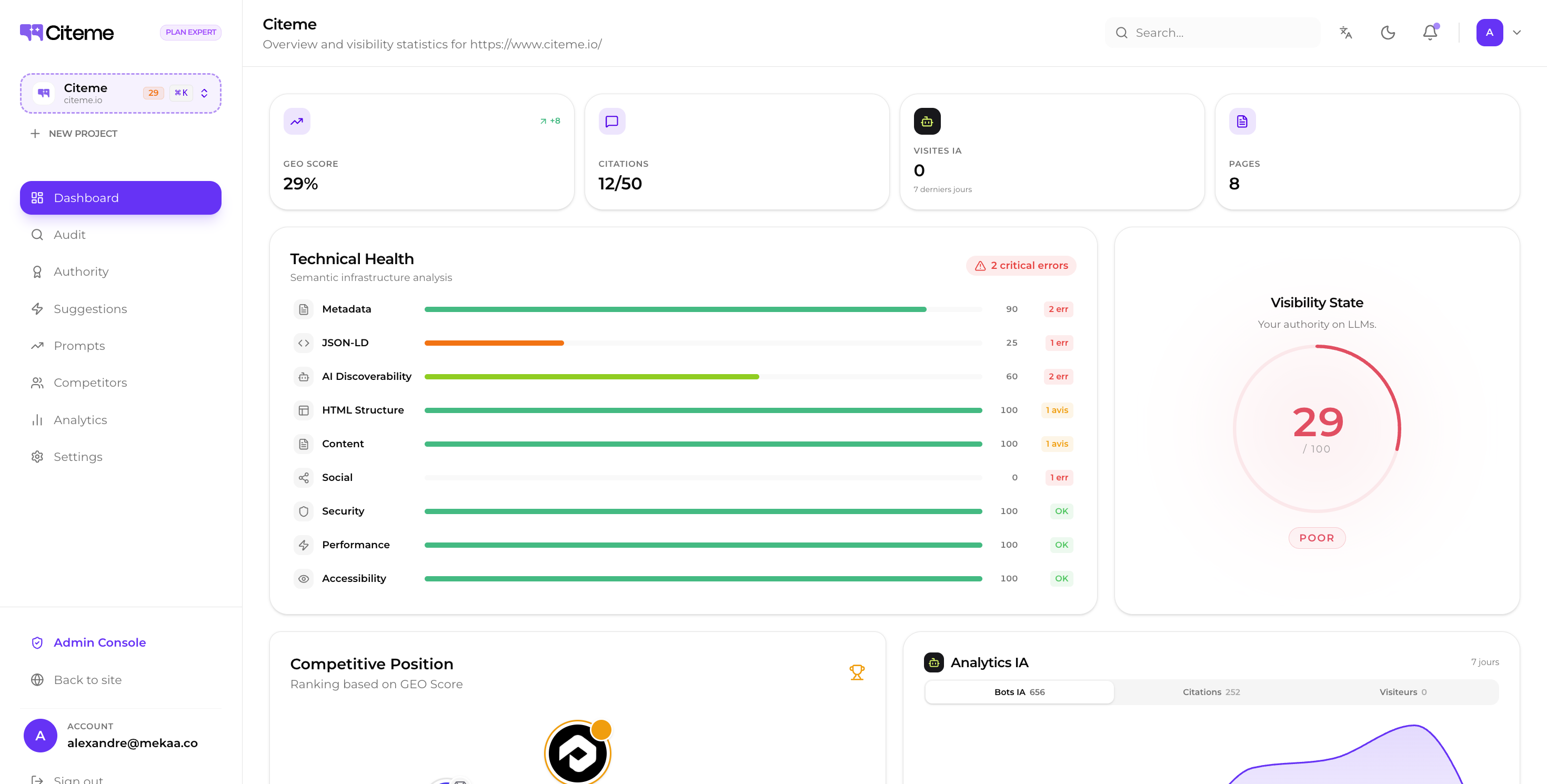
CiteMe is more precise on GEO. Where BabyLoveGrowth and Outrank optimize content to be cited by LLMs, CiteMe was built from the ground up for citation by generative engines: extractive structure, information density, formats LLMs love to ingest (sourced citations, hard data, short and self-contained paragraphs). On our test sites, the ChatGPT/Perplexity mention ratio per article published is meaningfully better with CiteMe than with the autopilot solutions. If you want to understand why this difference exists, we published a complete guide on GEO in 2026 that breaks down the logic.
CiteMe respects our editorial voice better. This is probably what tipped the scale. In a blind test, we had 5 people read (3 internal, 2 clients) a mix of articles produced by Outrank, BabyLoveGrowth, and CiteMe without telling them which was which. The CiteMe articles were the only ones nobody flagged as « generic AI content ». For us, that's the criterion that separates a usable tool from one that sabotages your brand long-term.
CiteMe + our copywriters remains the best equation. The lesson from this quarter is that none of these tools replaces a human who understands your business. But the right tool multiplies what a human can produce. CiteMe is what we internally call an « editorial assistant »: it does 60% of the work (research, structure, optimization, first draft), and our copywriters do the 40% that makes the difference (voice, opinions, concrete examples, tone). With BabyLoveGrowth or Outrank, the ratio inverts and human added value becomes a patch on already-standardized content.
Verdict for Mekaa: we stay on CiteMe for 2026. It's the best balance between AI productivity, editorial control, and GEO performance among everything we tested.
Comparison table: the 4 tools at a glance
Three lessons this quarter taught us about AI SEO tools
Lesson 1: the « autopilot » promise is partly a lie. None of the tested tools actually works without human intervention if you're aiming for quality. Either you accept standardized content (and pay the price in lost brand authority over 12 to 24 months), or you rework, and then autopilot becomes copilot.
Lesson 2: GEO changes the tool selection game. In 2026, the stake is no longer just « does my content rank on Google ». It's also « do ChatGPT, Perplexity, Claude cite me ». Tools that optimize only for Google do incomplete work. This is the criterion where most market solutions are starting to show their limits, and where CiteMe widened the gap.
Lesson 3: the real cost of a tool isn't measured by the subscription. Outrank at $99/month that needs 2 hours of rework per published article ends up more expensive than a $200/month tool that needs 30 minutes. The real cost is human time per publishable article. That's the metric we now systematically check before subscribing to anything.
What we're testing next quarter
We close this notebook with what we're planning next. Because being transparent: we're not stopping here.
On the program for next quarter: a deep dive on Surfer SEO 2026 edition (they shipped a major redesign of their GEO module), an experiment on custom Claude Skills agents for internal SEO (we already built three internally for Mekaa), and a benchmark of AI Overview monitoring tools (Profound, Otterly, and a few outsiders). If these topics interest you, the next article drops at the end of next quarter.
In the meantime, if you have specific questions about any of these tools or want us to look at your current SEO stack, contact us directly. We always reply, and we say what we think.